

There’s a statistic doing the rounds at the moment. In the government’s own words:
Let’s set aside the somewhat troubling fact that this framing locates the problem entirely with ‘the kids’… That would be a different blog.
Instead, let’s return to the data, and extrapolate this figure - a consistent finding from the last two DFE behaviour surveys. Seven out of every 30 classroom minutes… That’s:
14 minutes an hour
1 hour and 10 minutes across a 5-period day
5 hours and 50 minutes a week
41 hours across a 7-week term
227.5 hours (45.5 days) a year
227.5 days across 5 years of secondary school (from Year 7 to 11)
As Cilla Black might put it: that’s a lorra lorra lost learning time.
The opportunity cost, and the impact on children’s learning and future lives, is vast.
In this week’s Rethinking Behaviour webinar (released today as a podcast in which I look a bit like Holly out of Red Dwarf), my brilliant colleague Tara Elie painted the broad strokes:
Rising suspensions
Internal removals
Persistent absence
Staff exhaustion
The recent TES headline that teachers facing worse behaviour are more likely to quit. (In other news, pope wears funny hat…)

Before the webinar, we invited people to submit questions. I’ve been mulling over one in particular, posed by Melody in Madrid:
“After extensive research, we introduced a new Behaviour & Relationships Policy in September ‘25 - our challenge is getting staff to use it! (and yes they were involved in writing it.) Any tips would be gratefully received.”
It’s a refrain I hear fairly often. You did the research. You involved staff. You launched it properly. And yet, the policy isn’t being used consistently.
The question is: Why?
Hold that thought for a moment. Because to answer it properly, we need to take a step back…
Start with the trunk of the tree
In the session, I introduced a simple Root Cause Analysis tool known as the problem-solution tree.
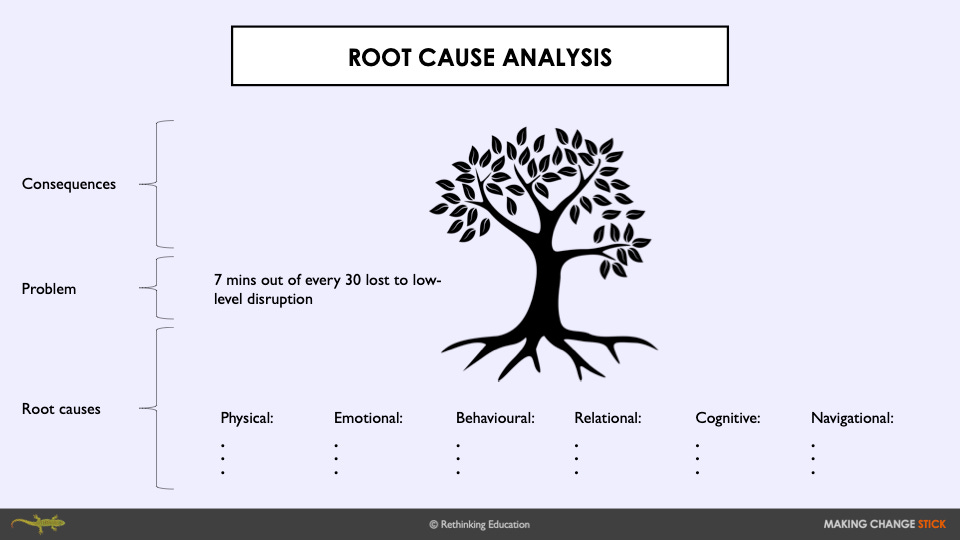
The metaphor explains itself really.
You begin with the trunk: the issue you want to address. In this worked example, we’ll use the statistic from the top of this post: seven minutes out of every thirty are lost to low-level disruption. This is the problem as it shows up in the day-to-day.
Many behaviour reforms identify a problem of this nature and then seek to remedy it. We see a nail, reach for the nearest hammer and take a swing. But often, we miss the target - or worse...
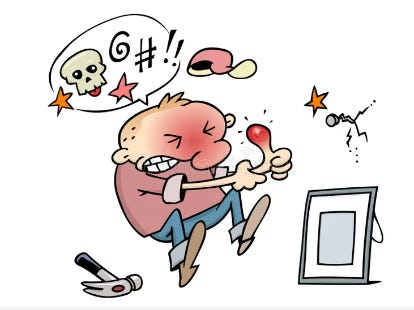
Root Cause Analysis insists that we slow down.
After identifying the trunk of your tree, the next step is to ask: what are the consequences? These are the branches.
To return to our example, if seven minutes of learning time are lost every half hour, attainment is likely to suffer. Escalation cycles become normalised. Students start to think “this is how we behave here.” Over time, relationships are damaged – between staff and pupils, and between colleagues – as trust begins to fray. Sanctions multiply – detentions, removals, exclusions. Teachers’ attention is split between instruction and correction. Workload, stress and burnout increase. Teachers start to Google ‘TES jobs’ - or perhaps even that Facebook group filled with ex-teachers looking like this…

But branches are still surface-level. They tell us what’s happening. They don’t tell us why.
Now look beneath the surface
The real work lies in the roots.
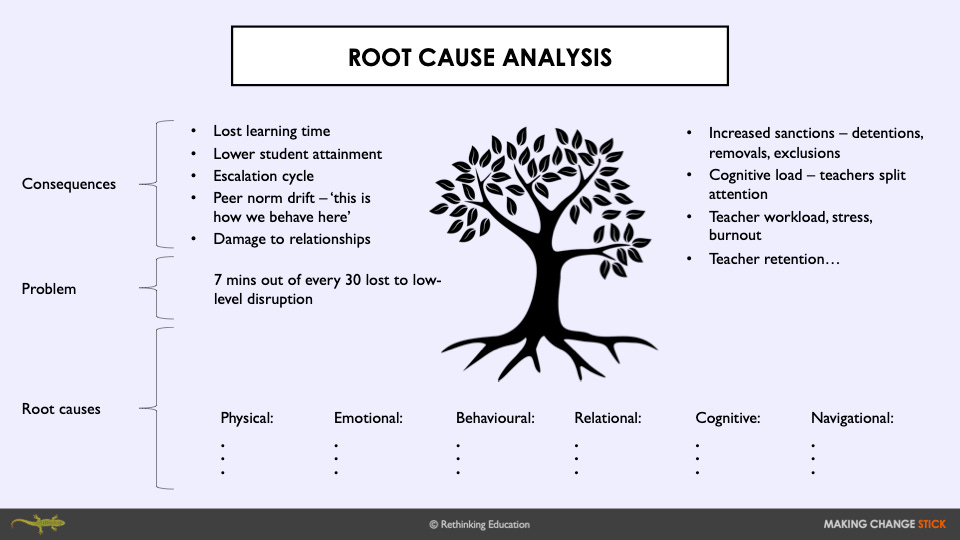
When we ran this exercise in the webinar, we explored how the roots of low-level disruption might sit across the six domains listed above:
Some roots are physical. Pupils who are tired, hungry, dehydrated, overstimulated. Staff who are stretched thin by workload and operating in a state of low-grade depletion. Behaviour is closely linked to biology.
Some roots are cognitive. Work that is pitched too high can trigger avoidance. Work that’s pitched too low can trigger boredom. Sustained teacher talk without structured participation can lead to attention wandering. Under cognitive overload, adults and pupils revert to default habits.
Some roots are relational. Perceived injustice is a powerful driver. So is low relational trust. If a pupil feels unseen or singled out, small corrections escalate. If staff feel that leadership decisions are made in a black box, a subtle ‘us and them’ dynamic can take hold.
And as Tara reminded us so eloquently, some roots relate to mattering (or, indeed, anti-mattering. Listen to the pod to play a sobering game of anti-mattering bingo…)
Rosenberg defines mattering as the experience of feeling valued and adding value. When that balance is disrupted – for pupils or for staff – behaviour shifts. Students who feel insignificant may seek attention in other ways. Staff who feel replaceable may withdraw discretionary effort. Neither response is irrational.
The key insight is this: the visible issue – seven minutes lost in every 30 – is an output of the system. In different contexts, in different schools, that output might be caused by entirely (or subtly) different root systems. If we don’t diagnose the root causes accurately, our improvement strategies are unlikely to actually, um, improve anything.
Root Cause Analysis changes the question from “How do we stop this?” to “What is producing this phenomenon in our context?”
The problem-solution tree exercise has one final stage. Once you’ve identified your root causes and set in place strategies to address them, cast your mind a year or so into the future.
Imagine that the root causes were correctly identified, that your improvement strategy has worked like a dream, and that the problem has been minimised - or even eradicated entirely.
How does your tree look now?
What blossom, fruits or flowers can you see?
It’s a heady thought experiment, and creates a powerful emotional anchor to draw you forward.
Meanwhile, back at Melody’s question
“After extensive research, we introduced a new Behaviour & Relationships Policy in September ‘25 - our challenge is getting staff to use it! (and yes they were involved in writing it.) Any tips would be gratefully received.”
I’m not sure this qualifies as a tip, but here’s my response to Melody:
If you want sustainable change, start at the roots. You need to understand why this happening, identify the implementation barriers, and then build a ‘complex intervention’ that tackles each barrier at its roots.
In other words, conduct a Root Cause Analysis where the trunk of your tree is “staff are not using the policy”.
Next, consider the consequences. This may include things like inconsistency between classrooms. Pupil confusion. Frustration among compliant staff. Increased leadership workload. Policy credibility eroding over time.
And then we move to the roots. This may involve assembling a slice team to explore these roots from a range of perspectives - experienced teachers, earl career teachers, classroom assistants, middle leaders, lunchtime supervisors - everyone who has a valuable perspective to share. What are the root causes? Explore the different domains in turn:
Physical: Are there structural pinch points – timetable, corridor transitions, class composition – that make consistent enactment harder than it appears on paper?
Cognitive: Is the policy easy to enact under cognitive load, or does it require complex judgement calls in the moment? Do staff understand how this policy connects to the wider goals of attendance, attainment and wellbeing?
Habitual: Have new routines been rehearsed sufficiently to become habitual, or are staff reverting to previous defaults?
Relational: Is there full relational trust between staff and leadership, or is there quiet scepticism?
And so on.
Until you conduct that Root Cause Analysis, at best you have an incomplete understanding of the problem you’re trying to solve. And when we guess, we tend to resort to compliance: “We’ll be coming around this week to check…” (And the teachers wearily Google ‘TES jobs’ once more…)
When we know, we can act with confidence:
If the issue is habit, we design rehearsal, and identify habit triggers and feedback loops.
If it’s lack of clarity, we simplify and reinforce.
If it is relational trust, we open the glass box and involve a representative slice team in ongoing refinement.
If it’s emotional risk, we increase psychological safety so staff feel free to seek support without fear of repercussion.
In short, we identify the implementation barriers - and address each one in turn.
The key insight - and an invitation…
Behaviour is complex, and the same core issues - behaviour being an ongoing challenge, staff not implementing the policy, the same kids in detention from one week to the next - are likely due to a combination of factors which are out of view, and highly context-dependent. So doing a Root Cause Analysis is a no-brainer.
But I don’t want to oversimplify this. RCA is just one way of thinking about behaviour in schools. Melody’s question might also benefit from writing and executing a comms plan, by optimising for habit change, by thinking about ‘tight but loose’ implementation - to name just a few…
Because every school is a bit different, a toolkit or a one-size-fits all approach is not the way forward. Instead, school leaders need to understand that there is a process they can follow to help them chart a course through the complexity.
If you’re currently wrestling with a policy that looks good on paper but isn’t landing in practice, the most useful next step may be a structured diagnostic conversation.
For a limited time only, we’re currently offering free 20-minute Behaviour Strategy Calls.
We’ll explore the dominant behavioural patterns in your setting, think through likely root causes, and consider what an improvement strategy and an implementation pathway might realistically look like.
Even if you decide not to pursue further work with us, most leaders find that these diagnostic conversations help sharpen their thinking.
You can book a slot here:
Seven minutes out of thirty is, as Cilla might say, a lorra lorra lost learning time.
It’s unacceptable, really.
Let’s start claiming it back.


