
Comms planning: The most overlooked (and easiest to fix) reason school improvement efforts fail
Why every school needs one – and how to write one today

About Making Change Stick
This newsletter features ideas and strategies from the Making Change Stick programme, an approach to school improvement developed over the last 10 years by Dr James Mannion, working in hundreds of schools all over the world.
Access a free taster course at makingchangestick.co
Find out more about James’s work at drjamesmannion.com
A fabulous and unique book. Every school leader should have a copy. I loved it.
― Steve Munby
Packed full of sage advice, practical activities and relevant worked examples.
― Rachel Macfarlane
A vital resource for making change not just possible but permanent.
― John Hattie
The most overlooked – and easiest to fix – reason school improvement efforts fail

When school improvement initiatives fail to achieve their goals, people often cite “communication breakdown” as the reason. But this phrase is misleading. It implies that communication was functioning well to begin with, and then deteriorated. In truth, without a clear plan in place, it’s unlikely that communications were particularly coherent or consistent in the first place.
This is one of the main reasons school improvement initiatives fizzle out. It’s also one of the easiest to fix.
Comms planning is standard practice in other fields such as business, politics and the charity sector – anywhere, in fact, where coordinated action across large groups of people is required. And yet, for some reason, it’s often completely overlooked in schools. This is a puzzling oversight.
Schools are complex organisations, often involving hundreds – sometimes thousands – of people, all working across different roles, systems and spaces. And yet very few schools have a coherent, strategic plan for what messages they want different groups to hear, when they want them to hear them, and how they plan to get those messages across.
Imagine running a business or political campaign without a comms plan – it would be unthinkable. And yet in schools, this crucial piece of the improvement puzzle is far too often missing in action.
A strong comms plan helps ensure that from the outset - and throughout the implementation period - people throughout the school community remain informed, engaged and invested in the process of bringing about lasting, positive change.
Here are six guiding questions to help draft your comms plan. I use the word draft because a comms plan is never written - rather, it should be updated regularly throughout the improvement process in response to what’s happening on the ground.
Six guiding questions
1. What’s the big story?
All messaging should fit within a clear, overarching narrative – your big story. This helps everyone understand what the initiative is about and why it matters.
Try to capture your story in a short, punchy phrase:
We’re creating an amazing pastoral support system.
We’re eradicating the attainment gap.
We’re improving behaviour and relationships.
We’re prioritising mental health and wellbeing.
We’re growing great learners.
We’re making sure learning is secured in long-term memory.
We’re creating a culture where every child reads for pleasure.
Note the use of we in each example. School improvement is a collective endeavour – the language you use should help people feel they’re part of it.
2. How will your messaging change as you progress?
Your messaging needs to evolve to keep people engaged. One way to think about this is to align your comms with the three phases of the Making Change Stick programme:
Phase I: Make a start
Raise awareness.
Appoint a slice team.
Phase II: Make a plan
Write a comprehensive implementation and improvement plan.
Anticipate problems and solve them in advance.
Phase III: Make it happen
Trial and refine.
Scale up and overcome barriers.
Embed and sustain improvements.
You don’t need to have everything figured out from the beginning – the key is to understand that your communications must change over time.
3. What language should you use?
The metaphors you choose matter. Think about how you narrate the journey of change.
‘Journey’ is a useful metaphor because it accommodates complexity – you can speed up, slow down, change course, or even aim for a new destination based on new information.
Avoid the language of launches. Launches are one-off events that are soon forgotten. Worse still, launch metaphors (rockets, cruise ships) imply something hard to steer. If you do use a vehicle metaphor, make sure it has a steering wheel.
Be alert to tentative language. Say:
We will close the gap.
When we close the gap…
Once we’ve closed the gap…
This frames your vision as a done deal. It’s just a question of reality catching up.
4. Who should deliver the messages?
Most messages are delivered by senior leaders. But when one person always talks about the same thing, predictability sets in – and people switch off.
Instead, think of your comms strategy as a chorus of voices. Different people delivering consistent messages through different channels to different audiences. The more people involved, the more likely your messages are to land well.
5. Who are your target audiences?
Internally, you’ll want to communicate with:
Senior leaders
Middle leaders
Teachers
TAs and LSAs
Admin and support staff
Pupils
Externally:
Parents and carers
Local services, charities and partners
Local authority or trust
Subject networks, researchers, inspectors
The local press (a great way to share positive stories)
6. Through which channels should you communicate?
Face-to-face is best – it’s human, engaging, and less prone to misinterpretation. But schools offer many other options. Here are four broad categories:
One-to-many (broadcast)
Staff briefings
Newsletters
Flyers
Social media
Assemblies
Lessons
Website updates
Emails
Webinars
Display boards
One-to-one
Phone calls
Personal letters or texts
Coaching sessions
Postcards
Many-to-one
Slice team inbox
Data collection
Suggestion boxes
Many-to-many
Parents’ evenings
Interactive workshops
Staff meetings
Coffee mornings and fetes
Tutor time discussions
Planning your broadcast comms
At the start of your initiative, focus mainly on one-to-many communications. Tell people what you’re doing, and keep them updated with clear, succinct messaging delivered through multiple channels.
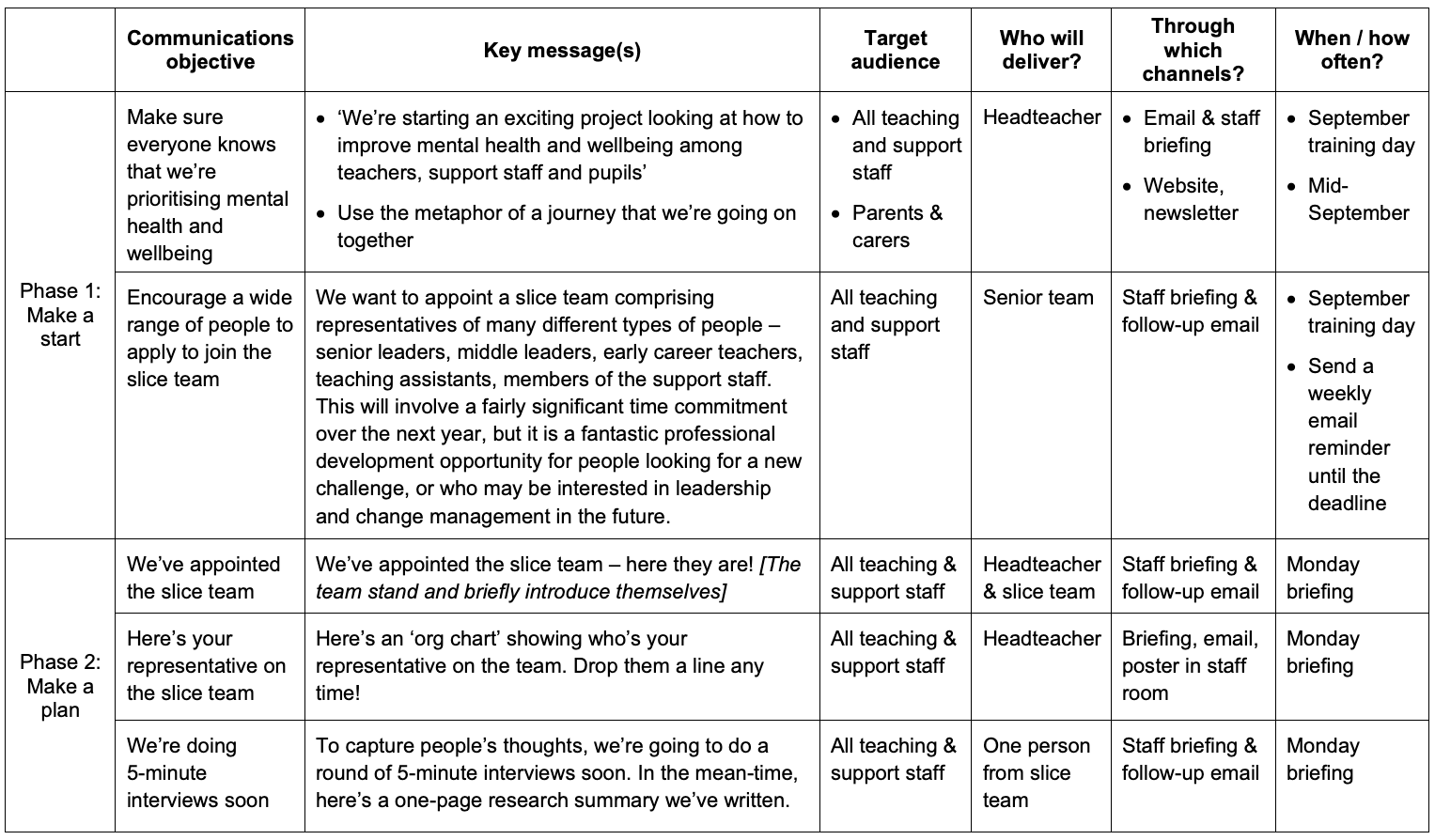
To create your own broadcast comms plan:
List your communications objectives.
Identify the key messages you need to deliver.
Identify your target audiences.
Choose who should deliver the messages.
Select appropriate channels.
Decide when – and how often – to deliver them.
Set calendar reminders to nudge people when it’s their turn to step up.
Here’s a worked example of. broadcast comms plan from a school prioritising mental health and wellbeing:
Final thoughts
One-to-many messaging is efficient. It helps convey key updates and narrate the journey of change. But broadcast comms alone won’t change behaviours. For that, you need to engineer ways for people to talk to other people about your improvement initiative. I’ll explore how to do this in a future post on the theory of diffusion of innovations — a foundation of implementation science.
For now, take the time to draft your comms plan. Get clear on the big story. Conduct a chorus of voices. Keep the messages flowing. And remember – without clear communication, even the best-laid plans are likely to come unstuck.